.png)
Murad was shopping for a new computer. The salesperson showed him several models with powerful processors, generous memory and dedicated AI capabilities.
“Are these computers designed for AI?” Murad asked.
“Yes. Some AI models can now run directly on the computer itself,” the salesperson replied.
“So I won’t always have to wait for a remote server to process my request?”
The answer sounds straightforward, but it points to a much bigger shift in computing. Microsoft wants to bring more AI processing onto users’ devices. That raises three important questions: how local AI will change the way people work, how their data will be protected, and whether the hardware needed to run it will be affordable.
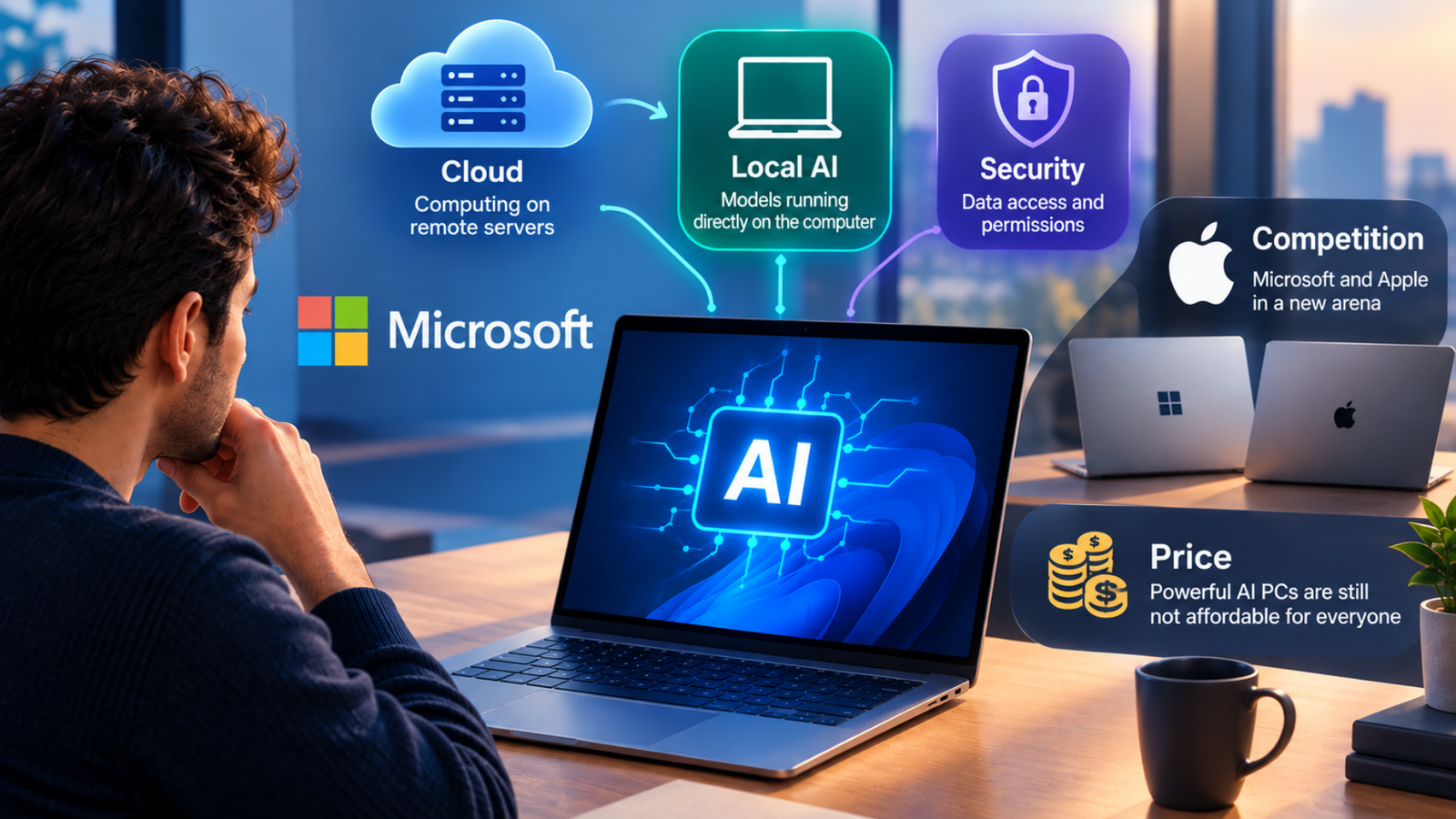
In recent years, many AI services have relied on powerful servers and enormous data centers. Users send a request from their computers, while much of the actual processing happens somewhere else.
Microsoft wants to change part of that model.
At an event in San Francisco, the company introduced technologies designed to run AI models directly on powerful Windows PCs. These include an AI coding model that can operate locally, as well as models such as Nvidia’s Nemotron.
According to Microsoft, a version of DeepSeek V4 can run on computers with at least 60GB of memory and may outperform OpenAI’s GPT-5 on certain coding and reasoning tasks.
The company is also bringing this approach to Copilot. Instead of sending every task to the cloud, the system is intended to distribute work between cloud-based and local models. Depending on the task, that could help balance privacy, performance and computing costs.
In other words, the PC is becoming more than a device that connects to AI services running elsewhere. It can handle some of the AI workload itself.
But that raises another question: if AI can do more directly on a computer, does that automatically make it safer?
AI agents are no longer limited to answering questions. They can write code, analyze information and carry out certain tasks on a user’s behalf. As their capabilities expand, controlling what they can access and what actions they can take becomes increasingly important.
Imagine an AI agent reviewing business documents and preparing a report. Does it need access to every personal file on the computer? What happens if it changes a file or transfers information without permission?
Microsoft has introduced a technology called Microsoft Execution Containers (MXC) to help address these risks. It is designed to prevent AI agents from accessing data or carrying out actions without authorization.
According to the company, Anthropic, OpenAI and Nvidia will also use the technology.
This matters because running AI locally does not automatically guarantee security. Keeping some processing on a personal device may help protect privacy in certain situations, but access controls and safeguards are still essential.
For businesses, that distinction is particularly important. As AI agents take on more work, companies will need to manage their permissions carefully and ensure that automated actions remain within clearly defined limits.
The shift toward on-device AI is also creating another front in the competition between Microsoft and Apple.
Apple continues to develop AI capabilities for its Mac computers. Microsoft, meanwhile, wants powerful Windows devices to become a new platform for AI computing.
The company has also introduced the Surface Laptop Ultra, equipped with Nvidia RTX Spark technology. Prices range from $2,599 to $5,899, depending on the configuration.
Those figures bring Murad’s original question back into focus: is it worth paying more for a computer with advanced AI capabilities?
The answer depends on what the user needs. Developers, professionals working with large datasets and people who rely on powerful local models may benefit from that extra computing capacity. Someone who mainly browses the web, writes documents and handles everyday tasks may not need all of it.
There is another complication. Rising memory-chip costs are putting pressure on the price of powerful AI hardware. As the technology becomes more capable, the cost of accessing it remains a significant barrier.
Running AI models directly on a PC could offer benefits in privacy, computing costs and convenience. But local processing will not be the best option for every model or task. Some models require substantial memory and powerful hardware, while cloud infrastructure will remain useful for many workloads.
The computers of the future may therefore be defined by more than processor speed. Their ability to combine local and cloud-based AI, protect sensitive information and deliver practical benefits will matter just as much.
Murad still has a decision to make. Choosing a computer is no longer just about comparing specifications. It is about whether the additional AI capabilities will make a meaningful difference to everyday work.
Would you pay more for a computer with powerful AI capabilities, or wait until the same technology becomes available on more affordable devices?
12-Oct-2026 19
You can get expert advice from OPTIMA specialists, clarify pricing, and order solutions. Contact us by calling or by requesting a call back.
