
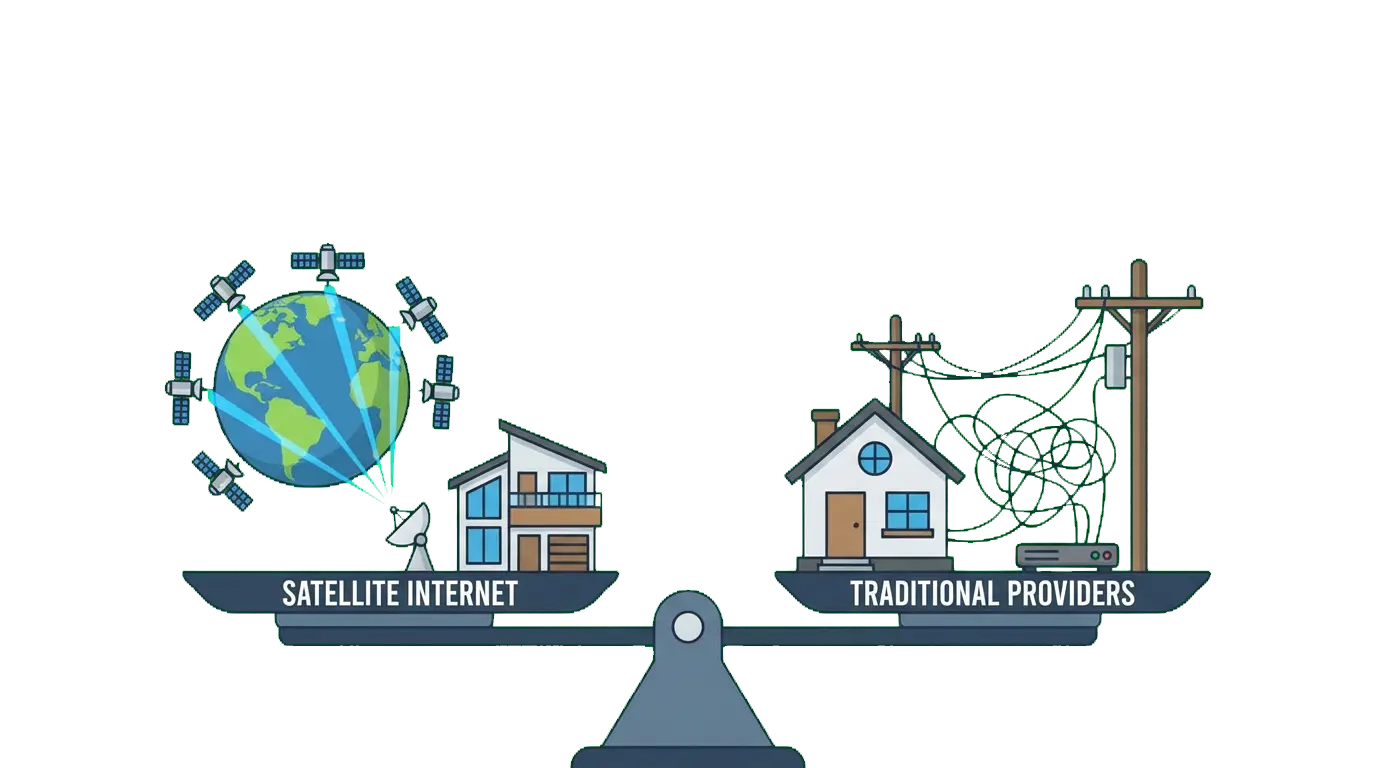
Starlink and Satellite Internet: Will It Replace Traditional Providers?
Imagine you have been destined to travel only by train for years. A train can be fast, but it only goes as far as the rails are laid. To reach beyond the mountains, remote forests, or islands, you must spend millions of dollars and wait years for those rails to be built. Now, someone comes along and offers you a private helicopter – it takes you directly to your destination regardless of where you are or the geography around you. This is exactly the difference between traditional cable (fiber-optic) internet and Elon Musk's Starlink project. Instead of rails digging under the ground, we have "digital helicopters" descending directly into our homes from the sky. But will this space technology completely relegate those thick cables in our homes and classic providers to history? Let's look at the data and realities.
Escape from Cables: Key Advantages of Satellite Internet
In the past, "satellite internet" brought to mind a slow, frequently interrupted, and expensive service used only on ships. Starlink, however, rewrote these rules with a new technology called LEO (Low Earth Orbit). Its main weapons against traditional providers are:
- Borderless Coverage: Traditional providers refuse to lay optical cables in remote villages and mountainous zones because it is not economically viable. For Starlink, the concept of "remote" does not exist. Every point that can see the sky — whether in the middle of a desert or a ship in the ocean — gains equal access to high-speed internet.
- Low Latency: Old satellites were located 35,000 km away from Earth, causing unbearable half-second freezes (ping) on the internet. Starlink satellites, however, fly just 550 km from Earth. This revolutionary proximity reduces latency to 20-40 milliseconds, reaching a level that competes with traditional cables for online games and video calls.
- Resilience in Emergencies: In extreme situations such as earthquakes, floods, or wars, terrestrial infrastructure, towers, and underground cables are the first systems to fail. Starlink, however, does not depend on terrestrial disasters. The moment you set up the antenna and connect it to power (even with a generator or solar panel), your connection to the world is restored.
Statistics: Space Internet in the Language of Numbers
Starlink's growth speed and impact are not just imaginary promises; they are proven by concrete statistics that are shaking the global market:
- User Explosion: According to 2024 data, Starlink already serves more than 4 million active subscribers worldwide, and this number is increasing exponentially every month.
- Satellite Army: Currently, more than 6,000 active Starlink satellites are orbiting the Earth. This constitutes more than half of all active satellites launched into orbit in human history.
- Speed Indicators: According to global test results, Starlink provides an average download speed of 100-250 Mbps in many developed countries (for example, in rural US and Australia), which is several times higher than the average speed of traditional providers in those regions.
Evolutionary Chronology of the Internet: From Copper to Space
If we chronologically trace how the internet came into our homes, we can see more clearly why the next step is indeed space:
- 2000s (The Bondage of Copper Cables): The era of slow internet provided over telephone lines (ADSL), which disconnected every time a call came in and where we waited minutes to download a single image.
- 2010-2023 (The Fiber-Optic Revolution): Glass cables carrying data at the speed of light. While speed and reliability were perfect, laying the infrastructure was very expensive and laborious. As a result, high-speed internet was concentrated only in the centers of large cities, while provinces remained in a "digital divide."
- 2025 and beyond (Space Network): The LEO era, where light signals travel not in cables, but directly in the vacuum of space (light moves 47% faster in a vacuum than in cables) through inter-satellite lasers. The internet is no longer dug from the ground; it rains from the sky.

Azerbaijan Reality: Cables or Space?
But can Starlink wipe traditional providers (Aztelekom, Baktelecom, and private companies) off the market in Azerbaijan? The answer to this question is both yes and no.
Currently, within the framework of the "Online Azerbaijan" project, the process of laying fiber-optic (GPON) cables everywhere in the country, even in remote villages, is moving very fast. In Baku and other large cities, traditional fiber-optic internet is much cheaper than Starlink (the price of Starlink equipment and monthly subscription fees are quite high) and provides a more stable speed. For this reason, it is currently illogical for a citizen living in a city center to cut their optical cable and switch to Starlink.
However, when it comes to our regions with mountainous terrain, offshore oil platforms, moving trains, or agricultural areas, Starlink is a true lifesaver. Imagine a user in the most remote village of Guba, nestled between mountains, obtaining the same speed as in the center of Baku simply by placing an antenna on the roof, without waiting for any cables. Also, Starlink will play the role of a perfect "Plan B" (backup) for large companies and banks. If the main optical cable is broken during excavation, the system will automatically switch to Starlink, and work will not stop for even a second.
Starlink and LEO satellite technologies were not created to completely "kill" traditional fiber-optic providers, but to fill the gaps they cannot reach. Glass cables will continue to rule beneath the cities, but the sky will pass entirely under the control of cosmic internet. For us, the main gain is competition. Traditional providers, feeling the breath of an invisible cosmic rival, will be forced to increase service quality and invest in more remote regions. Ultimately, whether it comes through underground cables or from space, the winner will always be the end-user who achieves fast and uninterrupted internet.