
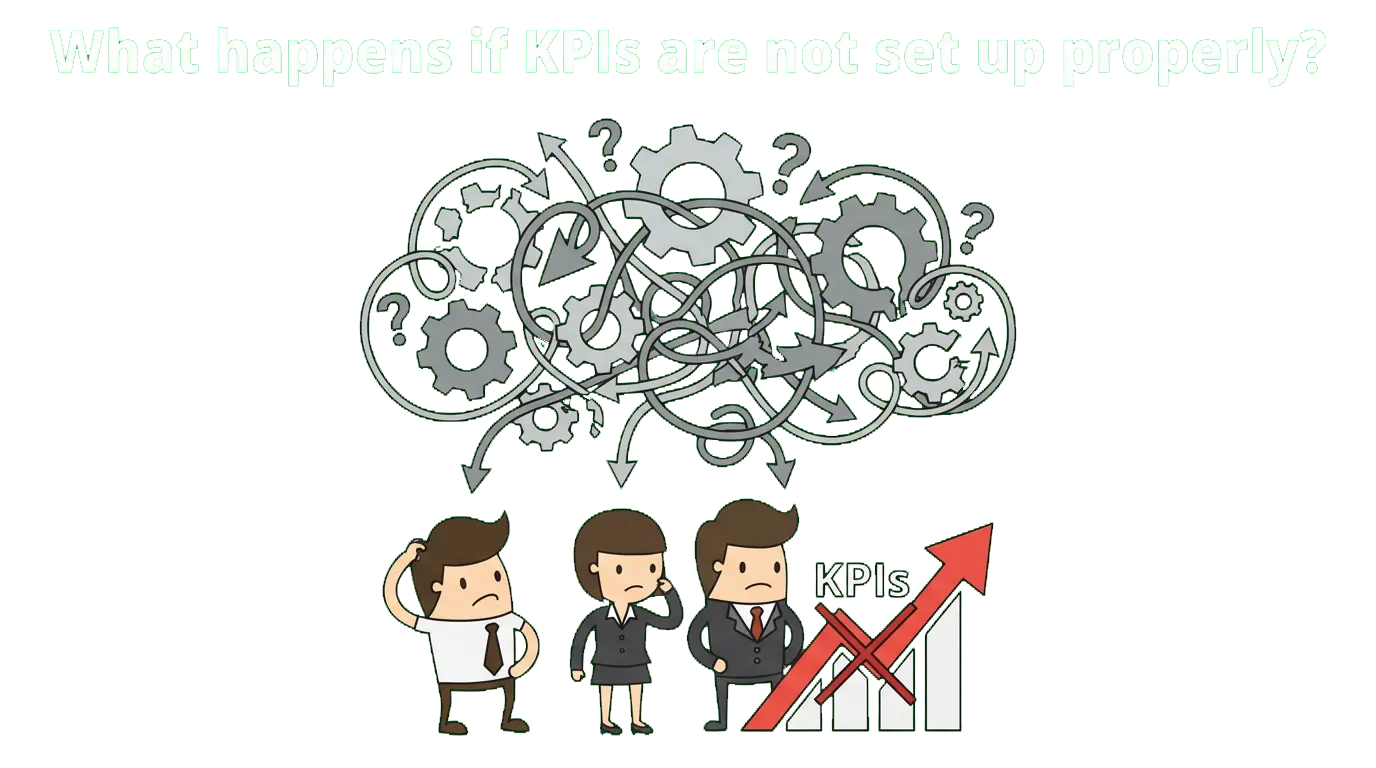
What Happens If KPIs Are Not Set Correctly?
There is a famous saying in the business world: “You can’t manage what you can’t measure.” However, there is a more dangerous side to this statement: “If you measure the wrong things, you manage the wrong way.” Key Performance Indicators (KPIs) are like the steering wheel of a company. If these indicators are not defined correctly, you may think you are moving fast, but in reality, you are heading toward a cliff. Many managers see KPIs merely as a tool to “monitor employees,” but unbalanced targets can turn into a hidden virus that slowly corrodes a company from within.

The Hidden Dangers of Wrong Targets: The “Cobra Effect”
When KPIs are poorly designed, employees begin to look for loopholes in the system to achieve their targets. This phenomenon is known in business as the “Cobra Effect” (where the solution to a problem creates outcomes worse than the problem itself). The main consequences of incorrect KPIs include:
- Quantity vs. Quality: for example, if a call center employee is given a target of “make 100 calls per day,” they may rush through short, meaningless conversations just to hit the number. As a result, the metrics look great, but customer satisfaction (CSAT) collapses.
- Internal Competition and Sabotage: when individual KPIs are overemphasized, employees stop helping each other. The mindset of “my target is met, the rest doesn’t matter” kills team spirit and pushes the company’s overall interests into the background.
- Short-Term Thinking (Short-termism): if a sales manager receives a bonus based only on this month’s sales, they may pressure a potential client who would normally close next month to buy now, or offer aggressive discounts. This means sacrificing future revenue for today’s numbers.
Statistics: The Numbers Are Warning Us
Research shows that poor performance management comes at a high cost for companies:
- Strategy Failure: more than 60% of global companies fail to achieve their strategic goals because their daily KPIs are not aligned with their overall strategy.
- Employee Turnover: in companies with demotivating or unfair KPI systems, the risk of talented employees leaving is 50% higher.
- Resource Waste: managers spend approximately 30% of their time reviewing irrelevant reports that have no real impact on decision-making.
Evolution Timeline: From Control to Inspiration
The approach to KPI systems has evolved significantly over the years:
- 2010s (The Control Era): KPIs were mainly a punishment mechanism. Employees who failed to meet targets faced salary cuts. The main focus was: “How much did you work?”
- 2018–2022 (The Balance Era): companies shifted to the Balanced Scorecard (BSC) approach. Alongside financial indicators, customer satisfaction and internal processes also began to be measured.
- 2025+ (OKRs and AI): today’s trend is OKRs (Objectives and Key Results) and AI-powered forecasting. The focus is no longer “How much did you work?” but “How much value did you create for the company?”

The Azerbaijani Reality and Common Mistakes
The most common issues encountered when implementing KPIs in Azerbaijan include:
First, the “Copy-Paste” approach: local companies often try to apply the KPI systems of global giants (such as Google or Amazon) exactly as they are. However, without considering the realities of the Azerbaijani market, employee mentality, and market size, these systems fail.
Second, the focus on penalties: unfortunately, in many local businesses, KPIs are seen more as a way to avoid salary cuts than to earn bonuses. This creates fear and stress among employees. In an effective system, however, KPIs should encourage development and growth.
It is encouraging that large holdings and the banking sector (for example, the Pasha Holding ecosystem) are already transitioning to more flexible OKR systems and evaluating employee satisfaction (eNPS) as a KPI.
KPIs are not a goal in themselves; they are a means to achieve a goal. A well-designed KPI is like a car’s navigation system—it shows you the safest and fastest route. A poorly designed KPI, on the other hand, is like a faulty map that leads you toward a cliff. Business owners must learn to see the people and the quality behind the numbers. Remember, some of the most important things cannot always be measured by numbers.